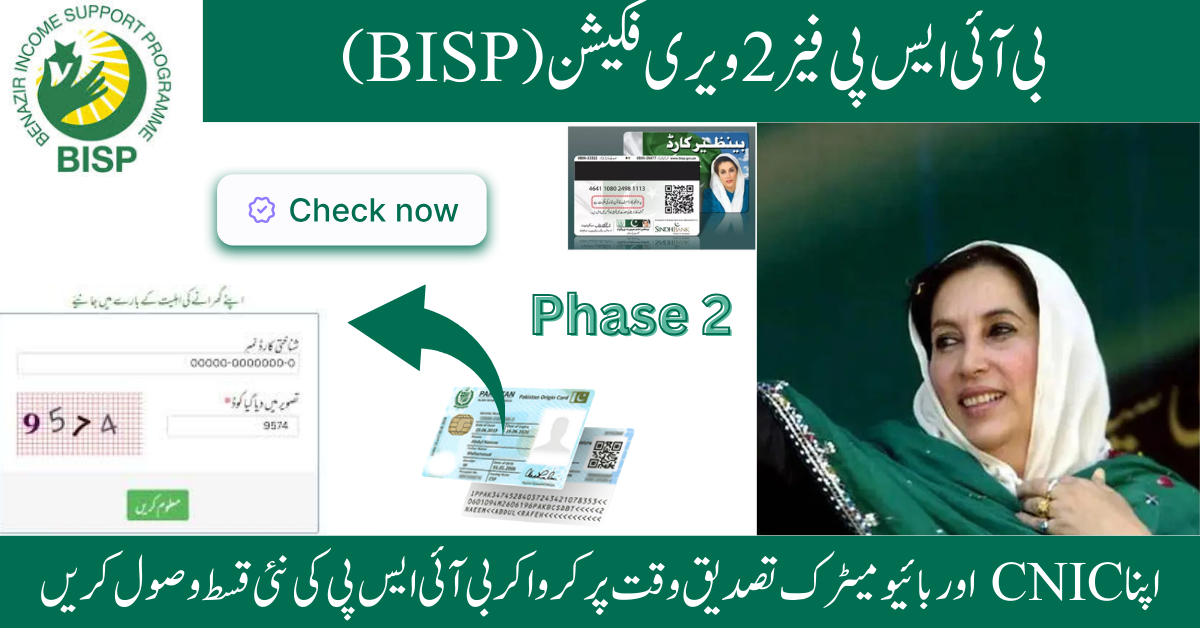
The Benazir Income Support Programme (BISP) is one of Pakistan’s most trusted social welfare initiatives, designed to provide financial aid to low-income families. In 2025, the program entered Phase 2 with a strong focus on digital transformation, bringing a more transparent, secure, and beneficiary-friendly system. From old campsite models to a banking-based system, the new phase allows beneficiaries, especially women, to open personal bank accounts and use secure payment methods for payments. As someone who has personally helped families during BISP registration, I’ve seen how these official processes and eligibility checks have simplified access to relief and financial aid.
If you’re searching for clear guidance to verify your status, validate your eligibility, and resolve issues during the BISP Payment Phase 2 Verification, this ultimate guide is here to help. You’ll learn the exact steps, required documents, and how to confirm CNIC status using biometric checks and banking channels introduced by the government. Understanding these updated processes ensures you receive your installment on time, avoid delays, and collect cash payments safely. The fresh updates, fraud prevention methods, and solutions explained here will help every participant confirm their details, follow official channels, and stay fully informed throughout the process.
Latest Developments in BISP Payment Phase 2 Verification 2025
The Government of Pakistan has taken strong steps in 2025 to improve the BISP system, bringing more transparency, safety, and control for all beneficiaries. Based on my field experience, these improvements have made it much easier for families—especially women—to manage their finances without worrying about fraud or manual payment handling. Here’s a simple breakdown of what’s new this year:
- A streamlined verification system has been launched for Phase 2 payments to ensure smoother disburses and quicker payment collection.
- The Bank Account System now allows direct transfers to personal bank accounts of beneficiaries in major cities like Karachi, Lahore, Quetta, Peshawar, Gilgit, and Muzaffarabad, cutting out middlemen completely.
- Biometric verification and CNIC verification can now be done through the 8171 web portal, SMS service, or SMS short code for convenience and transparency.
- The Digital Banking Pilot, started in collaboration with the State Bank of Pakistan (SBP) and Parliament’s committee, includes ATM access, debit cards, and digital wallets, reducing human handling and manual errors.
- Retail-Based Payment Outlets have replaced crowded campsite distributions, offering a safer retail payment model where retail outlets issue printed receipts after each transaction for added safety.
- New facilitation centers for widows, senior citizens, and differently-abled individuals ensure that everyone receives help without long queues or heat-related risks.
- The Upgraded CNIC Lookup System helps users check their assigned bank, branch, and scheduled appointment date (or scheduled visit date) through the official portal or web portal.
- These updates in the banking-based payment model make sure funds are distributed fairly and efficiently to those who need them most.
Step-by-Step Guide for BISP Payment Phase 2 Verification 2025
If you are a BISP beneficiary waiting for your Phase 2 Payments, this step-by-step guide will help you easily verify your CNIC and complete the BISP Payment Phase 2 Verification 2025 process. I’ve personally helped several families through this system, so let me walk you through each part in simple terms.
1. Start with the SMS Check
- Send your CNIC number to 8171 for instant verification through the 8171 SMS service.
- This step will help you confirm your eligibility and Phase Status directly from the official system.
- Make sure your SIM is registered under your name to avoid delays or errors during verification.
2. Visit the Online Portal
- Go to the official 8171 BISP portal for further verification.
- Enter your CNIC details correctly in the portal to check your assigned bank, branch, and appointment date.
- The upgraded system in 2025 ensures smoother processing and fewer rejections compared to before.
3. Go to the Payment Centers
- Visit the nearest BISP Tehsil Office or partner bank branch at your scheduled date or within your appointment window.
- Bring your original CNIC and all required documents to confirm your identity.
- The Banks are operating under a pilot rollout process, expanding city by city and district to ensure a fair rollout phase.
4. Complete the Biometric Scan
- At the counter, you’ll need to provide thumb verification for biometric verification.
- If your fingerprints fail, the NADRA Verisys system will act as a backup to verify identity.
- Once verified, your bank account will be activated or updated in the BISP database through BISP electronically.
- In case of repeated failures, you may be referred for biometric account activation again to ensure a successful process.
5. Collect Payment Securely
- After verification, you can withdraw funds from an authorised retail agent, retail outlet, or ATM.
- Use your debit card or ATM withdrawals for easy cash withdrawal.
- Always collect a printed receipt for record-keeping and safety.
- The designated bank may also offer ATM use or ATM activation support for new users.
6. Important Tips During the Rollout Phase
- Follow your fixed schedule and staggered schedules to minimize queues and overcrowding at the centers.
- Ensure your identity documents haven’t expire[d], and renew them in advance.
- If your payment holds due to biometrics fail or repeated biometric issues, visit your assigned bank or outlet for a bank update.
- Always capture details and confirm your verification message after each withdrawal to stay informed.
7. When the System Fails
If your biometric verification fails repeatedly, the Verisys system or backup will assist you. Sometimes, random branches are allowed for biometric account activation or to help resolve repeated biometric failures. Stay calm — the BISP team and authorised retail agents are trained to support beneficiaries through every step.
Pro Tips to Pass BISP Phase 2 Smoothly
When helping beneficiaries with BISP Payment Phase 2 Verification 2025, I’ve noticed that small mistakes can cause delays or even rejections. To make the process smooth and stress-free, here’s what you should do carefully and confidently:
- Always double-check your CNIC. It must be valid and contain correct details like your name and date of birth. Even small errors in names or dates can cause system problems.
- Visit only your officially assigned branch or outlet on the scheduled date mentioned in your verification message or appointment date. The system rejects random walk-ins and wrong branches, so timing and location really matter.
- Keep your printed receipt safe. Take a photo of it as proof and for record-keeping—it helps in case any issue comes up later.
- Avoid unnecessary visits to banks or other outlets before your scheduled time. This prevents confusion and keeps the process organized.
- Always rely on official SMS from 8171 or trusted BISP sources only. Ignore fake WhatsApp messages or phone calls that ask for personal information—they are signs of fraud.
- Use your phone to store important details or pictures of receipts so you don’t lose them later.
Following these steps will help you avoid issues, prevent rejections, and move smoothly through the process without stress or wasted effort.
Safety and Fraud Prevention Tips for BISP Beneficiaries
When it comes to BISP payments, staying safe from fraud is just as important as completing your verification or withdrawals. Many beneficiaries have been repeatedly advised through official channels to remain cautious and avoid sharing personal details with anyone. Based on my experience helping people through BISP processes, here are the most important safety measures you should always follow:
- Always trust official messages. Only rely on BISP announcements, SMS from 8171, or updates shared on official government or government pages.
- Never share your personal information. Do not send your CNIC copy, CNIC images, OTPs, debit card, or PIN to unknown callers or WhatsApp numbers—this is the most common way scammers try to steal money.
- Ignore fake calls and messages. Remember that BISP does not charge any fee or charges for registration, verification, or withdrawals. Anyone attempting to ask for payment is committing fraud.
- Stay alert and report. If you notice any suspicious activity, report directly to the BISP helpline or visit the nearest office for help. It’s always better to act quickly than to risk losing your funds.
- Follow official guidance. BISP regularly warns and advises people to be careful, and these repeated warnings are for your safety. Always remember—your awareness is your best protection.
Common Challenges Faced by Beneficiaries
-
- Many beneficiaries experience challenges during the BISP Phase 2 Verification process. The most frequent issue is biometric failure, which can be fixed by using NADRA Verisys or requesting a debit card for easier ATM withdrawals.
- If your CNIC has expired, your payments may be put on hold. Apply for CNIC renewal quickly to renew your status and resume receiving your funds without interruption.
- Visiting the wrong branch can lead to your request being rejected, so always go to the assigned outlet mentioned in the system.
- Sometimes, missing SMS from 8171 or inactive phones create confusion. Always use the official web portal to confirm your status and check for updates.
- Some applicants face issues because their information is not updated in NADRA records, or they encounter a biometric mismatch at the payment center.
- Problems may also occur if a wrong SIM is registered or there are inactive phone numbers, which delay important alerts.
- The best solution is to update CNIC, re-verify your mobile number, and visit the nearest BISP office for help to ensure smooth verification and payment release.
Conclusion
The BISP Phase 2 Verification process ensures that every beneficiary receives their rightful payments safely and efficiently. If you face biometric failure, expired CNIC, or missing SMS, don’t panic — these issues have simple solutions. By staying updated through NADRA Verisys, the official web portal, or visiting the nearest BISP office, you can quickly renew, re-verify, and resume your financial funds. Remember, staying alert and following official steps helps you avoid delays and keeps your verification smooth.
FAQs
Q1: What should I do if my CNIC is expired?
If your CNIC is expired, your payments will be on hold. Simply apply for CNIC renewal at NADRA, and your funds will resume once your record is updated.
Q2: How can I fix a biometric failure?
If you face a biometric failure, use NADRA Verisys for verification or request a debit card for ATM withdrawals to access your BISP payment easily.
Q3: What if I didn’t receive an SMS from 8171?
In case of a missing SMS from 8171, visit the official web portal to confirm your status or contact the nearest BISP office for assistance.
Q4: Why was my payment rejected at the branch?
Your payment may be rejected if you visit the wrong branch. Always go to the assigned outlet mentioned in your BISP record.
Q5: How do I update my information in NADRA records?
To avoid verification problems, ensure your NADRA records are updated. You can re-verify your mobile number and update CNIC details at the nearest BISP office.
